
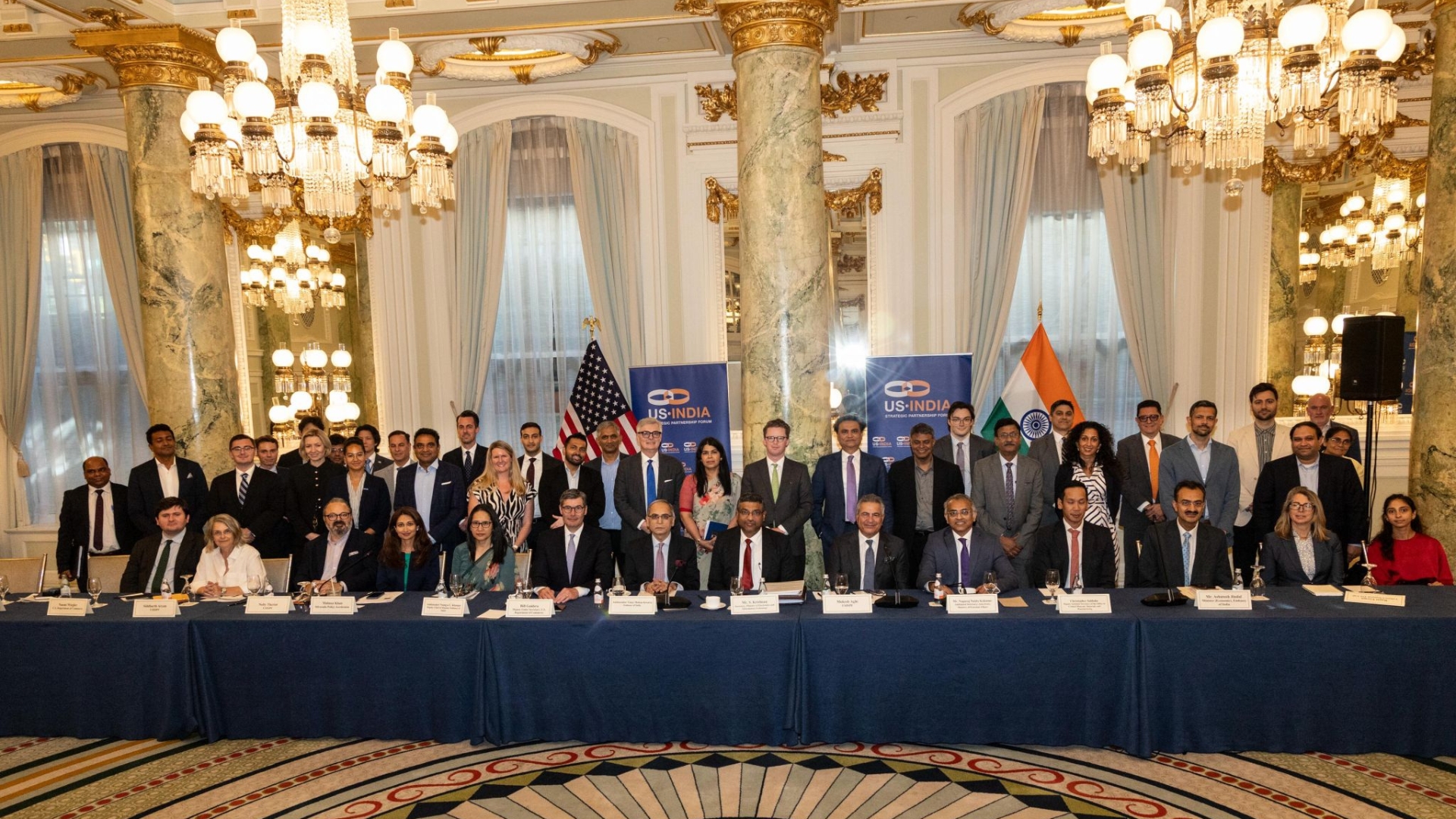
USISPF, in partnership with the Embassy of India in Washington, D.C., and the Silverado Policy Accelerator, was proud to host a high-level roundtable titled “Securing the Foundations of AI Together: U.S.–India Cooperation from Minerals to Microchips” in Washington, D.C.
USISPF was delighted to welcome Ambassador Vinay Kwatra, Ambassador of India to the United States, Mr. S Krishnan, Secretary, Ministry of Electronics and Information Technology (MeitY), Mr. K. Nagaraj Naidu, Additional Secretary (Americas), Ministry of External Affairs, India, Mr. Bill Guidera, Deputy Under Secretary for Innovation & Engagement, U.S. Department of Commerce and Mr. Christopher Saldana, Deputy Assistant Secretary, Office of Critical Minerals, Materials, and Manufacturing, U.S. Department of Energy (DOE).
The discussion convened diplomats, policymakers from both governments, and industry leaders working on semiconductors, AI, quantum technologies, and critical minerals who focused on advancing bilateral collaboration to securing critical supply chains, accelerating AI innovation, and building economic resilience.
USISPF President and CEO Dr. Mukesh Aghi kicked off the discussion, highlighting how microchips and critical minerals are the elixir of the modern economy and will define who runs the 21st century. Dr Aghi added: “The United States and India are uniquely positioned to build the trusted technology partnership of the 21st century. From semiconductors and AI to critical minerals and quantum technologies, government can establish the enabling framework, but it is industry that will ultimately drive execution, innovation, and investment. USISPF is proud to convene this dialogue to help translate strategic vision into tangible partnerships.”
Ambassador Vinay Kwatra, Ambassador of India to the United States, highlighted India’s mission-driven approach toward advanced technologies and the complementary strengths of both democracies.
“The opportunity before the United States and India extends from chips to neural networks. India’s mission-based approach across semiconductors, AI, and quantum technologies, combined with America’s innovation ecosystem, creates enormous potential for collaboration. Together, we can build trusted, resilient technology ecosystems while ensuring secure access to the critical infrastructure that powers these emerging technologies.”
S. Krishnan, Secretary, Ministry of Electronics and Information Technology (MeitY), Government of India, outlined India’s rapid emergence as a global electronics and semiconductor hub, noting the country’s expanding manufacturing ecosystem and growing leadership in AI.
“India is positioning itself as a trusted and resilient partner in the global technology supply chain. Our electronics manufacturing ecosystem has expanded dramatically, semiconductor fabrication is now becoming a reality, and the next phase of our Semiconductor Mission will build on this momentum. Combined with India’s talent, digital public infrastructure, and AI capabilities, we have an opportunity to develop solutions not just for India, but for the world.”
Speaking on the strategic direction of the bilateral partnership, K. Nagaraj Naidu, Additional Secretary (Americas), Ministry of External Affairs, Government of India, highlighted how recent government initiatives are laying the foundation for long-term collaboration.
“India and the United States have built a comprehensive strategic partnership fit for the 21st century. Through initiatives spanning AI, quantum technologies, critical minerals, advanced energy, and trusted supply chains, we are now moving from principles to projects. The private sector will play an indispensable role in transforming these frameworks into real-world outcomes.”
The industry-led conversation was moderated by Ms. Mahnaz Khan, Vice President of Policy Critical Supply Chains, Silverado Policy Accelerator, and Mr. Nolty Theriot, Senior Vice President, Government Affairs & Policy, USISPF.
The dialogue reinforced that as the United States and India deepen cooperation under their broader technology and strategic partnership, close collaboration between governments, industry, and research institutions will be essential to unlocking the full potential of these emerging sectors.
USISPF remains committed to serving as the premier platform connecting governments and businesses to advance the next generation of U.S.-India economic and technology cooperation.